World shares are mixed after another sell-off of AI stocks on Wall St, while oil prices ease
(AP) – World shares were mixed on Thursday following another sell-off of artificial-intelligence stocks that dragged the U.S. market sharply lower.
Oil prices fell after rising earlier as the U.S. launched a second round of airstrikes against Iran.
In early European trading, Germany’s DAX was nearly unchanged at 24,188.88 and the CAC 40 in Paris gained 0.4% to 8,192.55. The FTSE 100 in London added 0.5% to 10,307.39.
The future for the S&P 500 was up 0.8%, while that for the Dow Jones Industrial Average gained 0.7%.
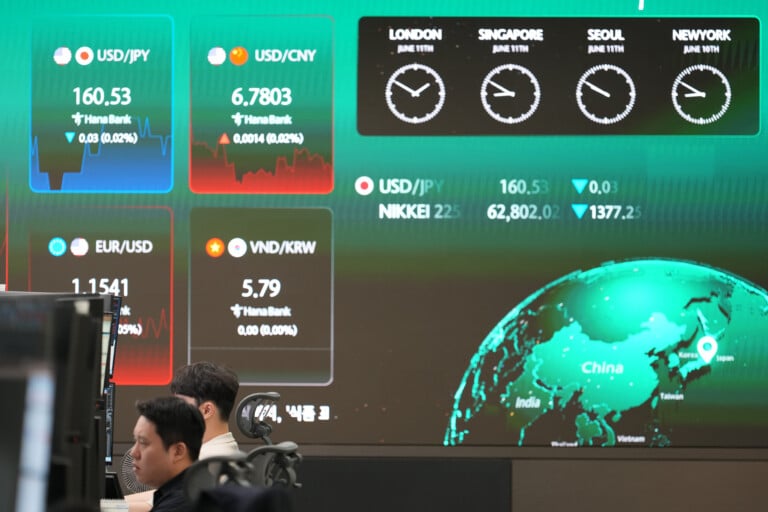
Tokyo’s Nikkei 225 edged up less than 0.1% to 64,217.27 after falling earlier in the day, while the Kospi in South Korea gained 0.4% to 7,763.95.
Hong Kong’s Hang Seng fell 0.7% to 24,249.29, while the Shanghai Composite index was down 0.2% to 3,987.01.
In Australia, the S&P/ASX 200 likewise shed 0.2% to 8,633.20.
Taiwan’s Taiex slipped 0.2% and India’s Sensex rose 0.2%.
On Wednesday, Wall Street’s former superstars continue to face heavy scrutiny.
The S&P 500 dropped 1.6% for its first back-to-back drop in three weeks. Closing at 7,266.99, it’s back to where it was in early May.
The Dow tumbled 1.9% and the Nasdaq composite led the market lower with a 2% slide.
Wall Street has been shaky since last week, when AI stocks went from roaring to records to suddenly turn lower. Among the worries is that their prices may have shot too high, too fast because of AI mania. The question now is whether the break lower has cleared out excessive optimism that may have built into their stock prices, or if it’s the start of a longer downturn.
Micron Technology swung from an early loss of nearly 4% to a modest gain and back to a loss of 4.7%. It’s coming off a wild stretch where it sank 7.7% last Thursday, then plunged another 13.3% Friday and rallied 9.9% Monday.
Nvidia, the chip company that’s grown into a nearly $4.9 trillion behemoth because of the AI boom, was the heaviest weight on the S&P 500 after falling 3.7%. The second heaviest was another AI winner, Broadcom, which fell 5.1%.
Some of the pressure on AI stocks could also be coming from investors pulling cash out to prepare for high-profile debuts on the U.S. stock market for several AI giants. SpaceX’s initial public offering could come later this week, for example.
Early Thursday, Brent crude oil, the international standard, fell $1.30 to $91.80 per barrel. It was at around $70 a barrel before the start of the war in late February.
U.S. benchmark crude oil was down $1.22 to $88.81 a barrel.
Oil prices climbed on Wednesday after President Donald Trump warned Iran would “pay the price” for stalled negotiations between the two sides. The war in the Middle East has been keeping the Strait of Hormuz effectively shut to oil tankers, which has prevented the delivery of crude from the Persian Gulf to customers worldwide.
High oil prices have sent inflation higher, and a report on Wednesday showed that prices for U.S. consumers jumped in May at the highest speed in three years.
Traders are betting the Federal Reserve will have to hike its main interest rate at least once this year, given price pressures and the strength of the U.S. job market.
High yields can slow entire economies and undercut prices for all kinds of investments, including stocks and cryptocurrencies. They hit investments seen as the most expensive in particular, and some critics are calling AI a bubble where investment inflated too far.
In other dealings early Thursday, the dollar slipped to 160.54 Japanese yen from 160.56 yen. The euro fell to $1.1534 from $1.1537.